The definitive guide to custom corporate t-shirts in 2026. Compare fabrics (cotton, polyester, blends), printing methods (screen print, DTG, embroidery), fits, and costs. Trusted by 1,500+ brands.

Media

Got questions? Ask me!
💬
Tashya
Got questions? Ask me!
💬
Tashya
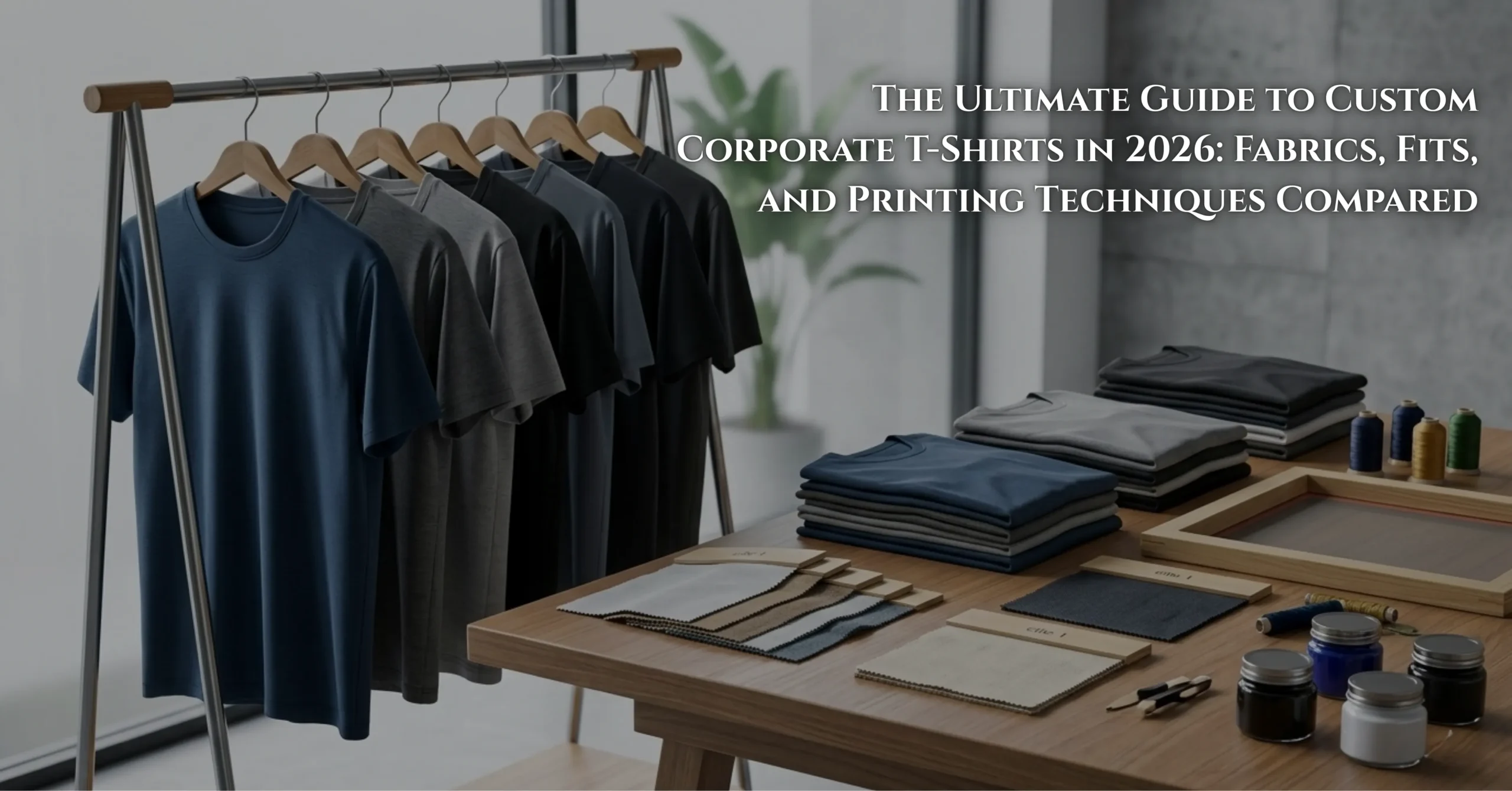
The definitive guide to custom corporate t-shirts in 2026. Compare fabrics (cotton, polyester, blends), printing methods (screen print, DTG, embroidery), fits, and costs. Trusted by 1,500+ brands.
The definitive guide to custom corporate t-shirts in 2026. Compare fabrics (cotton, polyester, blends), printing methods (screen print, DTG, embroidery), fits, and costs. Trusted by 1,500+ brands.
A custom corporate t-shirt is one of the most powerful branding tools a company can invest in. It is worn, seen, photographed, and remembered. Unlike digital ads that disappear in seconds, a well-made branded t-shirt can generate thousands of impressions over its lifetime while building team cohesion, strengthening brand identity, and creating a sense of belonging among employees and event attendees.
But here is the challenge most procurement managers, HR teams, and marketing professionals face: the sheer number of choices. Cotton or polyester? Screen print or embroidery? Regular fit or oversized? 140 GSM or 220 GSM? The wrong decision does not just waste budget. It results in t-shirts that sit in drawers unworn, undermining the very brand impression you set out to create.
This guide eliminates the guesswork. Drawing on 14 years of experience manufacturing custom corporate apparel for over 1,500 international brands, we break down every decision you need to make, from fabric selection and fit to printing technique and care instructions, so your next order delivers t-shirts your team will actually want to wear.
The fabric you choose is the single most important decision in your custom t-shirt order. It determines how the shirt feels against the skin, how it performs in different climates, how well it holds a print, how long it lasts through repeated washing, and ultimately, how often the wearer reaches for it over other options in their wardrobe. Get the fabric right, and everything else falls into place.
Cotton remains the gold standard for comfort. It is soft, breathable, and has a natural feel that most people prefer for everyday wear. However, not all cotton is created equal. The quality of a cotton t-shirt depends on the type of cotton, the way it is spun, and the weight of the finished fabric.
Combed Cotton: The fibers are combed to remove short strands and impurities before spinning. The result is a smoother, softer, and more durable yarn. Combed cotton t-shirts feel noticeably better against the skin and hold their shape longer than regular cotton.
Ringspun Cotton: The cotton fibers are continuously twisted and thinned, creating a finer, stronger yarn. Ringspun cotton produces a softer hand-feel compared to standard open-end cotton and provides a better surface for printing. If you want a premium feel without moving to blends, ringspun cotton is the sweet spot.
Organic Cotton: Grown without synthetic pesticides, fertilizers, or genetically modified seeds. Organic cotton carries certifications like GOTS (Global Organic Textile Standard) and appeals to companies with strong ESG commitments. The hand-feel is similar to conventional cotton, but the environmental footprint is significantly lower. Water usage in organic cotton farming is reduced by up to 91 percent compared to conventional methods.
Pro Tip: For corporate orders in tropical climates like Malaysia and Singapore, 100% cotton works beautifully for indoor, air-conditioned environments. For outdoor events, team-building activities, or any situation involving physical activity, consider cotton-polyester blends or Cotton Dri-Fit for moisture management.
Polyester is the performance fabric of choice. It wicks moisture away from the skin, dries quickly, resists wrinkles, and holds color exceptionally well through repeated washing. Modern microfiber polyester is far softer than the scratchy polyester of decades past, though it still does not match the natural softness of cotton.
Polyester is the required fabric for sublimation printing, which means it is the go-to for all-over prints, full-color photographic designs, and sportswear. It is also the base material for most recycled fabric options, with rPET (recycled polyester made from post-consumer plastic bottles) becoming an increasingly popular choice for sustainability-focused corporate orders.
Best for: Sports jerseys, outdoor events, performance wear, athletic team uniforms, and any situation where moisture management is a priority.
Blends combine the comfort of cotton with the performance benefits of polyester. The ratio matters significantly and determines which fiber’s characteristics dominate.
CVC (Chief Value Cotton) blends contain more cotton than polyester, typically 60/40 or 65/35. They feel predominantly like cotton but with improved durability, reduced shrinkage, and better color retention. CVC blends are the most popular choice for corporate t-shirts because they balance comfort, cost, and longevity.
TC (Chief Value Polyester) blends contain more polyester than cotton, typically 65/35 polyester to cotton. They lean toward performance characteristics: faster drying, more wrinkle resistance, and lighter weight. TC blends work well for uniforms that need to maintain a crisp appearance throughout long workdays.
Cotton Dri-Fit technology represents a breakthrough in corporate apparel. Developed to solve a common frustration, the stickiness and discomfort of pure polyester in humid tropical climates, Cotton Dri-Fit blends the natural softness of cotton with the moisture-wicking performance of synthetic fibers.
The result is a fabric that feels like your favorite cotton t-shirt but performs like a sports jersey. Sweat is drawn away from the skin and distributed across the fabric surface for rapid evaporation, keeping the wearer dry and comfortable during physical activities, outdoor events, or simply navigating the heat and humidity of a Southeast Asian afternoon.
Cotton Dri-Fit is particularly well-suited for corporate events, team building activities, company runs, and any branded apparel that needs to perform across both air-conditioned offices and outdoor settings. At SaltyCustoms, this technology has become one of our most requested fabric options for corporate clients who refuse to compromise on either comfort or performance.
GSM (grams per square meter) measures fabric weight and density. It is one of the most important specifications to understand when ordering custom t-shirts, as it directly affects how the garment feels, drapes, and holds up over time.
| GSM Range | Weight Class | Feel | Best Use Cases |
| 120-150 GSM | Lightweight | Thin, airy, casual | Event giveaways, one-day events, large-volume budget orders, promotional tees |
| 150-180 GSM | Mid-weight | Balanced, comfortable | Everyday corporate wear, office casual, moderate-budget orders, most popular range |
| 180-220 GSM | Heavyweight | Substantial, premium | Premium branding, retail-quality merch, streetwear-inspired corporate, long-term uniforms |
| 220+ GSM | Super Heavy | Thick, structured, luxury | Limited edition drops, executive merchandise, fashion-forward corporate lines, collectible items |
Industry Insight: The 2026 trend in corporate apparel is firmly moving toward heavyweight basics. Companies are investing in 180-220 GSM t-shirts that feel premium and durable, sending a clear message about brand quality. The days of thin, disposable promotional tees are ending. Research from the promotional products industry shows that 45 percent of corporate buyers now cite longevity as the most important feature when selecting branded merchandise.
Fit is where brand personality meets wearability. The same logo on a boxy, oversized tee communicates something entirely different than the same logo on a tailored, slim-fit polo. Your fit choice should align with your brand identity, your audience’s preferences, and the practical context in which the garment will be worn.
The most universally flattering option for corporate orders. Regular fit provides comfortable room through the chest and body without being too loose or too tight. It works across the widest range of body types, which makes it the safest choice for large-scale corporate orders where you are dressing a diverse team.
Best for: Company-wide orders, event merchandise, client giveaways, and any scenario where you are ordering for a large group with varied body types and preferences.
A more tailored silhouette that sits closer to the body without being tight. Slim fit conveys a modern, fashion-conscious brand image. It tends to be preferred by younger demographics and fashion-forward companies, particularly in the tech and creative industries.
Best for: Tech startups, creative agencies, fashion brands, and companies targeting a younger demographic. Be cautious with slim fit for large corporate orders as sizing can be less forgiving.
The dominant trend in 2026. Relaxed and oversized fits feature dropped shoulders, a boxy silhouette, and extra room throughout. This streetwear-inspired aesthetic has crossed over into corporate merchandise as companies embrace more casual, inclusive workwear.
Best for: Creative industries, tech companies with casual culture, Gen Z-focused branding, limited edition merchandise drops, and companies that want their merch to feel like desirable fashion rather than corporate obligation.
Inclusive sizing is no longer optional in corporate merchandise. The best practice in 2026 is to offer a unisex option as the default, with gender-specific alternatives available for those who prefer them. Unisex cuts are typically based on men’s sizing with a slightly adjusted fit. For the most inclusive approach, provide a detailed size chart and consider offering two fit options (regular and relaxed) so every team member finds something comfortable.
When working with a merchandise partner like SaltyCustoms, discuss your team’s demographics during the consultation phase. An experienced partner will recommend fit options that balance brand consistency with individual comfort, and can provide size sampling to ensure the final order fits your team perfectly.
Your printing technique determines how your design looks, feels to the touch, holds up over time, and what it costs per unit. There is no single best printing method. The right choice depends on your design complexity, order quantity, budget, fabric type, and the impression you want to make.
| Method | Best For | Colors | Durability | Cost at Scale | Min. Order |
| Screen Print | Bulk orders, bold designs | 1-6 spot colors | Excellent (50+ washes) | Very low per unit | 50+ pieces |
| DTG | Complex art, small runs | Unlimited (CMYK) | Good (25-50 washes) | Higher per unit | 1+ piece |
| Embroidery | Logos, polo shirts, caps | Up to 15 thread colors | Outstanding (100+ washes) | Moderate | 10+ pieces |
| Sublimation | All-over prints, sportswear | Unlimited (CMYK) | Permanent | Moderate | 10+ pieces |
| Heat Transfer | Names, numbers, small batches | Varies by vinyl type | Good (25-40 washes) | Low-moderate | 1+ piece |
| High-Density | Premium tactile branding | 1-4 colors | Excellent | Premium | 50+ pieces |
Screen printing pushes ink through a mesh stencil onto the fabric. Each color requires a separate screen, which is why screen printing is most cost-effective for designs with fewer colors. Setup costs are spread across the entire order, so the per-unit cost drops dramatically as quantity increases. For orders above 200 pieces with designs of one to four colors, screen printing is almost always the most economical and durable choice.
The print quality is exceptional. Screen-printed inks sit on top of the fabric, producing vibrant, opaque colors that pop even on dark garments. A quality screen print will withstand 50 or more wash cycles without significant fading or cracking.
DTG works like an inkjet printer for fabric. It sprays water-based inks directly onto the garment, allowing for unlimited colors, photographic detail, and smooth gradients without any setup costs. This makes DTG ideal for complex, multi-color designs and smaller order quantities where screen printing setup fees would inflate the per-unit cost.
DTG performs best on 100 percent cotton in light colors. Dark garments require a white underbase layer, which can slightly affect the hand-feel. While DTG has improved significantly in recent years, screen printing still edges it out in terms of raw durability and vibrancy at large volumes.
Embroidery stitches your design directly into the fabric using colored threads. Nothing communicates premium quality quite like embroidery. It adds a three-dimensional texture and a polished, professional appearance that printing methods cannot replicate.
Embroidery is priced by stitch count rather than quantity of colors. Simple logos with clean lines are the most cost-effective. Highly detailed or photographic designs are not suitable for embroidery as the needle cannot reproduce fine detail. The ideal applications are corporate logos on polo shirts, caps, jackets, and any garment where you want to convey premium brand positioning.
Embroidery is by far the most durable customization method. The design is physically woven into the garment and will outlast the fabric itself. For corporate uniforms that need to maintain a professional appearance through hundreds of wash cycles, embroidery is the undisputed champion.
Sublimation uses heat to turn solid dye into gas, which then bonds permanently with polyester fibers. The result is a print that is literally part of the fabric rather than sitting on top of it. This means sublimated prints do not crack, peel, or fade. The colors remain vivid and the fabric retains its original softness and breathability.
The trade-off is that sublimation only works on white or very light polyester fabric. It is the go-to method for sports jerseys, all-over printed designs, and any garment where you want edge-to-edge, photographic-quality graphics.
High-density printing is a specialized screen printing technique that creates a raised, three-dimensional effect on the fabric. Multiple layers of thick ink are built up to produce a tactile, almost rubber-like texture that you can feel with your fingertips. This technique transforms a simple logo into a premium brand statement.
High-density printing is increasingly popular among brands that want their corporate apparel to stand out. The tactile quality of the print communicates craftsmanship and attention to detail, which is why it commands a premium price point. It works best with bold, simple logo designs and is particularly striking on heavyweight, dark-colored garments.
The most common delays and quality issues in custom t-shirt orders stem from design file problems. Getting your artwork right from the start saves time, money, and frustration.
Left chest (heart side): The standard corporate placement. Clean, professional, and understated. Typical size is 8-10 cm wide. Works with every printing method and garment type.
Center chest: A bolder, more statement-oriented placement. Typical size is 25-30 cm wide. Best for event merchandise, promotional tees, and designs meant to be noticed.
Full back: Maximum visibility from behind. Ideal for event staff identification, team activities, and promotional messaging. Typical size is 30-35 cm wide.
Sleeve print: Subtle, modern, and increasingly popular in 2026. Works well as a secondary placement alongside a chest or back print. Great for sponsor logos on event merchandise.
Nape or collar print: A discreet placement inside the collar area, often used for internal branding, taglines, or replacing manufacturer labels with custom labels.
For the cleanest print results, always provide your design files in vector format (AI, EPS, or PDF). Vector files can be scaled to any size without losing quality. If you only have raster files (PNG, JPG), ensure they are at least 300 DPI at the final print size. A low-resolution logo might look fine on screen but will appear pixelated and unprofessional when printed on fabric.
For screen printing, provide your design with colors separated or identified by Pantone (PMS) color codes to ensure exact color matching. For DTG and sublimation, CMYK color mode produces the most accurate results. Your merchandise partner should provide a mockup for approval before production begins, so you can verify placement, sizing, and color accuracy.
Understanding the ordering process helps you plan timelines and set realistic expectations with your internal stakeholders. A typical custom corporate t-shirt order follows these stages:
Step 1 — Consultation and Brief: Share your requirements including quantity, preferred fabric, printing method, design files, and delivery deadline. An experienced merchandise partner will ask the right questions to recommend the best options within your budget.
Step 2 — Quotation: Receive a detailed quotation covering fabric, printing, finishing, packaging, and shipping costs. Compare unit costs at different quantity tiers to optimize your budget.
Step 3 — Design Mockup and Approval: Review digital mockups showing your design on the chosen garment. Approve placement, sizing, colors, and overall look before anything goes to production.
Step 4 — Sampling (Recommended for New Orders): For first-time orders or premium projects, request a physical sample. This allows you to evaluate the fabric, fit, print quality, and color accuracy in person before committing to the full production run.
Step 5 — Production: Once approved, production begins. Standard turnaround time is typically 7 to 10 business days depending on order size and complexity. Rush orders may be available at a premium.
Step 6 — Quality Control: Rigorous multi-point inspection including fabric quality checks, print accuracy verification, stitching integrity, sizing consistency, and packaging standards. At SaltyCustoms, quality control is built into every stage of the production process, from raw material sourcing to final packing.
Step 7 — Packaging and Delivery: T-shirts are folded, individually poly-bagged (or your preferred packaging), and shipped to your specified destination. Global shipping is available with tracking and customs documentation for international orders.
Planning Tip: Start your order process at least 4 to 6 weeks before your event or distribution date. This allows time for consultation, sampling, production, quality control, and shipping, with a buffer for unexpected delays. For large orders (1,000+ pieces) or custom-dyed fabrics, allow 6 to 8 weeks.
The lifespan of a custom t-shirt depends as much on how it is cared for as how it was made. Including care instructions with your order (either on a printed insert or via a digital resource linked by QR code) helps recipients get the most out of their garments and protects your brand investment.
Washing: Turn the t-shirt inside out before washing to protect the print. Use cold water (30 degrees Celsius or below) to prevent shrinkage and color fading. Avoid bleach. Use a gentle cycle for printed garments.
Drying: Air drying is always the safest option for preserving both fabric quality and print integrity. If using a dryer, choose a low heat setting. High heat can cause shrinkage in cotton garments and may damage certain print types over time.
Ironing: Never iron directly over a screen print, DTG print, or heat transfer. Iron on the reverse side or place a thin cloth between the iron and the print. Embroidered garments can be ironed normally.
Storage: Fold printed t-shirts rather than hanging them to prevent shoulder bumps and stretching. Store in a cool, dry place away from direct sunlight to preserve color vibrancy.
Understanding the cost drivers helps you make smart trade-offs and get the best value from your budget. The primary factors that determine unit cost are:
Fabric type and GSM: Organic cotton and specialty blends like Cotton Dri-Fit cost more than standard cotton. Heavier GSM fabrics cost more than lightweight options. The premium is typically 15 to 30 percent for sustainable or performance fabrics.
Order quantity: This is the single biggest lever on per-unit cost. Going from 100 pieces to 500 pieces can reduce unit costs by 30 to 40 percent, particularly for screen-printed orders where setup costs are amortized.
Printing method and complexity: Screen printing with one to two colors is the most cost-effective at volume. Adding colors, print locations, or switching to embroidery increases cost. High-density printing and specialty finishes command a premium.
Number of print locations: Each additional print location (front, back, sleeve, nape) adds to the cost. A single left-chest print is the most economical; a front plus back plus sleeve combination costs significantly more.
Customization extras: Custom labels, hang tags, branded packaging, individual poly-bagging, and custom-dyed fabrics each add incremental cost but significantly elevate the perceived value of the final product.
Budget Optimization Tip: If you are working within a tight budget, focus your spend on fabric quality and fit rather than elaborate printing. A well-fitting, comfortable t-shirt in premium fabric with a simple one-color screen print will be worn far more often than a cheap, ill-fitting tee with a complex multi-color design. Quality garment plus simple print beats cheap garment plus expensive print every time.
[Schema Markup: FAQPage schema recommended for this section]
For most corporate applications, a CVC blend (60 percent cotton, 40 percent polyester) offers the ideal balance of comfort, durability, and cost-effectiveness. For tropical climates, Cotton Dri-Fit technology provides cotton comfort with moisture-wicking performance. For premium branding, 180 to 220 GSM ringspun or combed cotton delivers a retail-quality feel. For sustainability-focused orders, GOTS-certified organic cotton or recycled polyester (rPET) aligns with ESG goals.
Pricing varies based on fabric, GSM, printing method, and quantity. As a general guide, budget between $5 and $15 USD per unit for standard quality corporate t-shirts with screen printing in quantities of 200 or more. Premium options with heavyweight fabric, embroidery, or specialty printing can range from $15 to $35 USD per unit. Requesting a quotation with your specific requirements is the best way to get accurate pricing.
Embroidery is the most durable customization method, with designs lasting the lifetime of the garment. For printed methods, screen printing on cotton provides excellent durability through 50 or more wash cycles. Sublimation printing on polyester is technically permanent as the dye becomes part of the fiber. DTG printing is the least durable of the major methods but has improved significantly, with modern DTG prints lasting 25 to 50 washes with proper care.
Minimum order quantities vary by supplier and printing method. Screen printing typically requires 50 or more pieces per design to be cost-effective. DTG printing can accommodate orders as low as one piece, but per-unit costs are higher. At SaltyCustoms, SaltyBASICS offers a starting minimum of just 10 pieces, while SaltyORIGINS caters to larger bulk orders with premium custom-made goods.
Standard production turnaround is 7 to 10 business days from design approval to shipment, depending on order size and complexity. Custom-dyed fabrics or highly customized orders may require 3 to 4 weeks. Rush production is sometimes available for time-sensitive projects. Always allow an additional 3 to 7 business days for shipping depending on your location.
For outdoor events in warm or humid climates, a cotton-polyester blend or Cotton Dri-Fit is recommended. Pure cotton absorbs moisture and can become heavy and uncomfortable during physical activity. Polyester or performance blends wick moisture away from the skin and dry faster. If your event involves sports or physical activity and requires sublimation printing for vibrant all-over designs, 100 percent polyester is the way to go.
The right custom corporate t-shirt is a powerful intersection of brand identity, fabric science, printing craftsmanship, and thoughtful design. When these elements come together, the result is a garment that employees wear with pride, event attendees keep for years, and your brand benefits from thousands of organic impressions.
At SaltyCustoms, we have spent over 14 years perfecting this intersection for more than 1,500 international brands, from startups ordering their first 50 team tees to multinational corporations producing 100,000 pieces for global distribution. As Asia’s first apparel consultancy firm, we do not just take your order. We guide you through every decision, from fabric selection and fit to printing technique and packaging, to ensure your custom t-shirts deliver maximum impact.
Ready to get started? Contact our team for a free consultation and let us help you create custom corporate t-shirts that your team will actually want to wear.